Just a quick note: As I already stated on my lenses page, one thing that bugged me when I was looking into the SOOKY-M (SOMKY) device, was the distinct lack of info available online. I’ve therefore made the manual available as a download.
Posts Tagged ‘lenses’
SOOKY-M
Friday, November 13th, 2009 by BernardAs I mentioned back when I explained the lens I’m using for the Leica Lessons project, I was really tempted by the Dual-range Summicron. In the end I decided against it, but mentioned in the footnotes that if I would end up missing the close range too much, I could always get a SOMKY adapter.
Well, I just did.
I love using the Leica, and it does pretty much everything I want from a camera. I’m surprised at how little I miss my Canons, quite frankly ((Which bothers me a bit, as I have quite a bit invested in that system.)), but one thing keeps bugging me: The lack of close focus. Product shots, and of course flower photography are hard or impossible without excessive cropping, so in the end I caved.
I managed to find one in excellent condition, with manual ((Which was pretty important, as there is frightingly little info on this device available online.)) and in the original red box. I’ll be testing it out over the coming period, and keep you posted. I already posted some info on the lenses page.
The lens
Thursday, August 6th, 2009 by BernardIn addition to a camera, I also needed a lens for the Leica Lessons project. In the rules I specified this had to be a Leica lens, and as I mentioned yesterday, I’ll be using a 50mm lens.
That still leaves a lot of options.
A site that was of much value to me was this one, which list pretty much all M lenses ever made.
With mount and focal length set, one parameter left was the maximum aperture. I’ve always had good experience with the `slightly slower’ fifty, the model just below the f1.4 mainstream lens, like my Canon 50mm f1.8 or my Pentax 50mm f1.7, which strike a nice bargain between light, size/weight, image quality and price. The Leica equivalent here is the fabled Summicron.
Vain as I am, I preferred a chrome lens to go with my chrome body ((Although I didn’t have the body yet when shopping for lenses, I was pretty sure the collectors’ premium on a black M3 would be pretty pointless, and out of my target price range.)). I also wanted a compact lens (one of the reasons I went for a Summicron over a Summilux).
My fondness of flower photography first had me looking seriously at the DR Summicron, but in the end I decided against that for several reasons ((Should, during the coming year, the lack of close-focus ability become too big a bother, I can always look around for a SOMKY adapter)):
- It’s too good. It’s often hailed as the best Leica 50mm. I felt using the best of the best contravenes the spirit of the project.
- It’s complex. The dual range aspect of the lens practically turns it into two lenses. As the assignment says one lens, that feels like cheating.
- It’s expensive. The high quality of the lens make good copies highly sought-after.
- It’s big. As I have to carry the camera everywhere, I wanted something compact. The DR is the biggest 50mm Summicron to date.
This led me back to a series of lenses that intrigued me even before I learned more about Leica lenses: Collapsible lenses. As an SLR shooter, this concept has always seemed genius to me: The ability to simply slide the lens back into the body of the camera, giving a near-flat package for transport.
Looking around, these are considered good, if slightly dated lenses, and available for reasonable prices as well. So here she is:
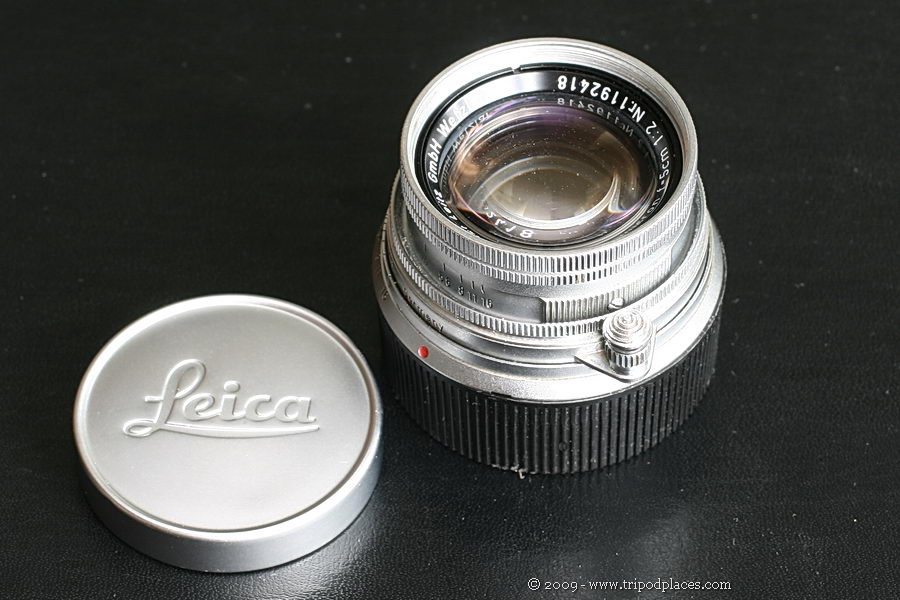
Leica lens 1192418, build in Wertzlar in 1954. Unlike the camera, I got this from a seller in the States, so I did get to pay a nice customs premium, but it’s in excellent condition, and came with original front and back caps ((Interestingly enough, the ad specified it only came with a rear cap. After I bought the lens, when it was still in transit, I contacted the seller if it really didn’t come with a front cap, since I was shopping for a lens hood and matching cap. The seller confirmed it didn’t come with one, yet when it arrived, there most definitely was a front cap on it. I’m not complaining though.)). Only downside of the American heritage is the fact that the distance scale is in feet instead of meters. However, I was always pretty good in guestimating distances in feet when I played (British) table-top games, so I don’t think it’ll really matter in the end.