Archive for August, 2009

First week

Monday, August 17th, 2009 by

Well, the first week is over. I shot about 6 rolls, most of which were `calibration shots’: bracketing like hell and checking the contact sheets for best exposure.


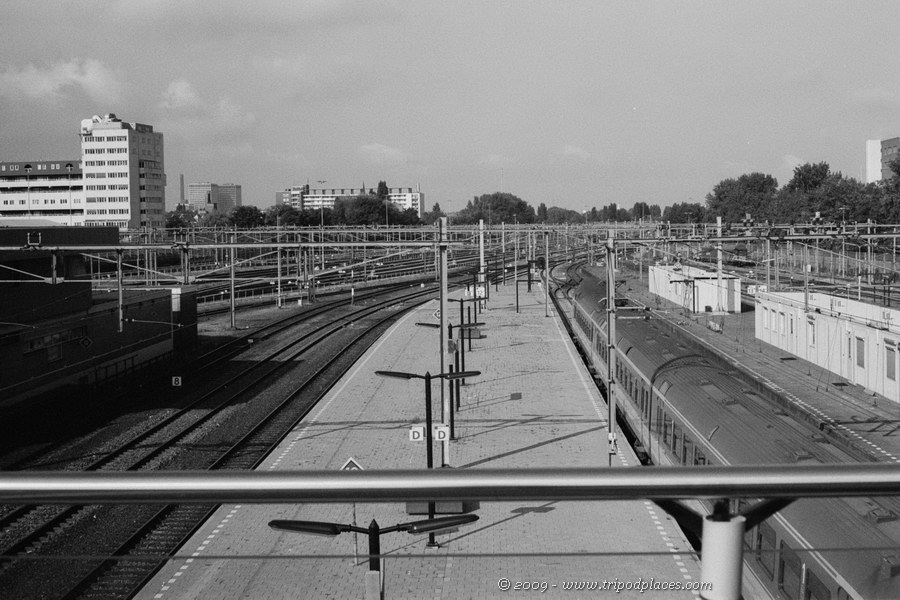
When scanning, I was once again surprised by the big exposure latitude of negative film. This shot was the +1 exposure from a `Sunny sixteen’ batch, and gave a better image than the real sunny sixteen exposure. Expose for the shadows, I guess. (That’ll take a while to get used to.)

Another lesson learned this week was that when Mike Johnston said to make notes, he meant it. During the calibration rolls, I made a few unbracketed shots ((In situations where bracketing wasn’t appropriate or possible. Snapshots)), guessing exposure as best as I could. In some cases, I didn’t write down what exposure I used. As Murphy dictates, those exposures were dead-on, but I have no idea what values I used…

It starts

Monday, August 10th, 2009 by

Well, the Leica Lessons project has officially started. I shot my last frame of Velvia around midnight, and this morning at breakfast I loaded the first roll of Neopan into the Leica.

Today I’ll shoot a lot of `calibration’ frames, setting some base exposures for common lighting situations. I’m cheating a bit, using this chart to get a close guess for an Ev value and then bracketing 2 stops above and below that. Making notes along the way of course.

Updates

Sunday, August 9th, 2009 by

Just a quick note that I’ve added the equipment for the Leica Lessons project to the equipment pages. Details are still limited, as I haven’t actually shot anything with this stuff yet.

I’m using this weekend to finish the rolls of film left in each of my cameras, as today is the last chance to use those. I foresee a lot of business for my lab this week…

The film

Saturday, August 8th, 2009 by

The final item ((Or more specifically, going at an average of 2 rolls a week, at least 100 items.)) needed for the Leica Lessons project is a film, a black and white film to be exact.

I wanted to use a 400 ASA film, which I’ve found is a nice all-round speed. I also wanted to use a `real’ B&W film, as opposed to a chromogenic film. In this speed, 5 types are well available to me: Kodak T-Max, Kodak Tri-X, Ilford Delta, Ilford HP5 and Fuji Neopan.

As I have absolutely no experience with B&W film, I decided to to a comparison. My demands for the final film:

  • Good detail
  • Not too grainy
  • Capable of being pushed to 1600 ASA ((For those tricky indoor tungsten shots, and those times I lose my sanity and decide to do sports-photography with a rangefinder.))

For the comparison, I got two rolls of each, and shot a collection of scenes on each of them. One roll at 400 ASA, the other at 1600. I also bracketed each scene at +1 and -1 stop.

I’ll post the resulting pictures here in the near future, but the short of the story is: I didn’t see enough difference to base a valid choice on.

Since I didn’t have any real preference, a final deciding factor came into play: price. Thanks to the wonderful website Fujilab.co.uk, I can get all Fuji films in bulk, and at less than half the price I pay for other brands through normal retailers. As I have good experience with Fuji for my other films and didn’t dislike Neopan in the test shots I decided to just take the easy way out, and use Neopan 400 for my `one film’.


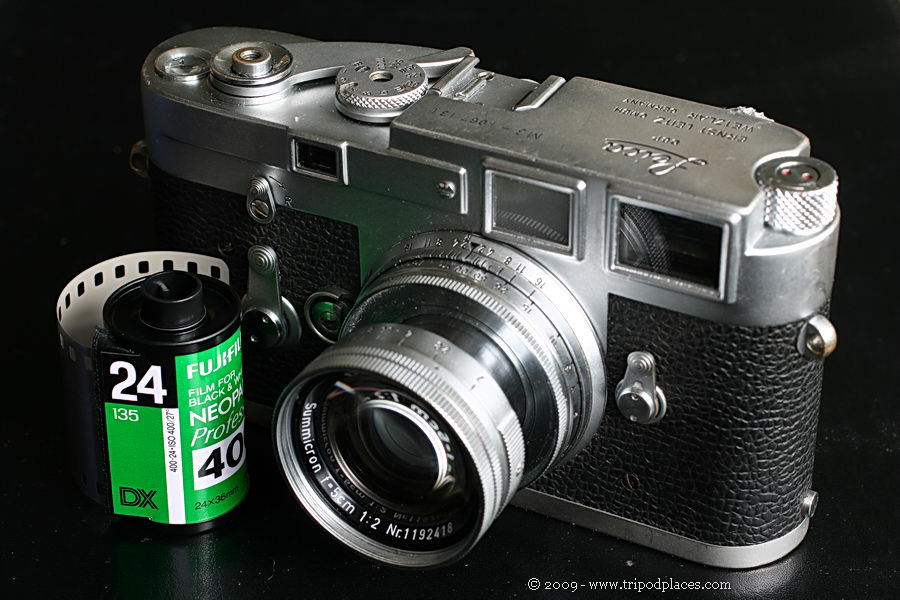
With that, the set is complete: Leica M3, 50mm Summicron collapsible and Fuji Neopan 400, my choice of photographic equipment for the upcoming year.

Ducks in evening mist

Friday, August 7th, 2009 by


In between all the gear-talk, time for a real picture.

I shot this late in the evening after a hot day. The water was cooling rapidly, casting a fine mist, and the setting sun gave it a warm glow.

Technical details

Shot with my Canon 400D, using an old manual-focus, T2-mount 500mm f8.0 lens, branded Sunagor. I might even have had a 2x extender in there as well, I can’t remember. This is a glass lens, not a mirror lens, and wide open it’s pretty soft, as you can see. Still, it was only 1% of the price of a Canon 500mm ((Though I doubled the price by adding a Wimberley lens plate to it. Tripods, wonderful things.)).

Why I like it

The softness of the lens, combined with the mist and distance combine for painting-like effect. As someone who usually strives for sharpness, I’m honestly surprised. I guess it pays to experiment.

The lens

Thursday, August 6th, 2009 by

In addition to a camera, I also needed a lens for the Leica Lessons project. In the rules I specified this had to be a Leica lens, and as I mentioned yesterday, I’ll be using a 50mm lens.

That still leaves a lot of options.

A site that was of much value to me was this one, which list pretty much all M lenses ever made.

With mount and focal length set, one parameter left was the maximum aperture. I’ve always had good experience with the `slightly slower’ fifty, the model just below the f1.4 mainstream lens, like my Canon 50mm f1.8 or my Pentax 50mm f1.7, which strike a nice bargain between light, size/weight, image quality and price. The Leica equivalent here is the fabled Summicron.

Vain as I am, I preferred a chrome lens to go with my chrome body ((Although I didn’t have the body yet when shopping for lenses, I was pretty sure the collectors’ premium on a black M3 would be pretty pointless, and out of my target price range.)). I also wanted a compact lens (one of the reasons I went for a Summicron over a Summilux).

My fondness of flower photography first had me looking seriously at the DR Summicron, but in the end I decided against that for several reasons ((Should, during the coming year, the lack of close-focus ability become too big a bother, I can always look around for a SOMKY adapter)):

  1. It’s too good. It’s often hailed as the best Leica 50mm. I felt using the best of the best contravenes the spirit of the project.
  2. It’s complex. The dual range aspect of the lens practically turns it into two lenses. As the assignment says one lens, that feels like cheating.
  3. It’s expensive. The high quality of the lens make good copies highly sought-after.
  4. It’s big. As I have to carry the camera everywhere, I wanted something compact. The DR is the biggest 50mm Summicron to date.

This led me back to a series of lenses that intrigued me even before I learned more about Leica lenses: Collapsible lenses. As an SLR shooter, this concept has always seemed genius to me: The ability to simply slide the lens back into the body of the camera, giving a near-flat package for transport.

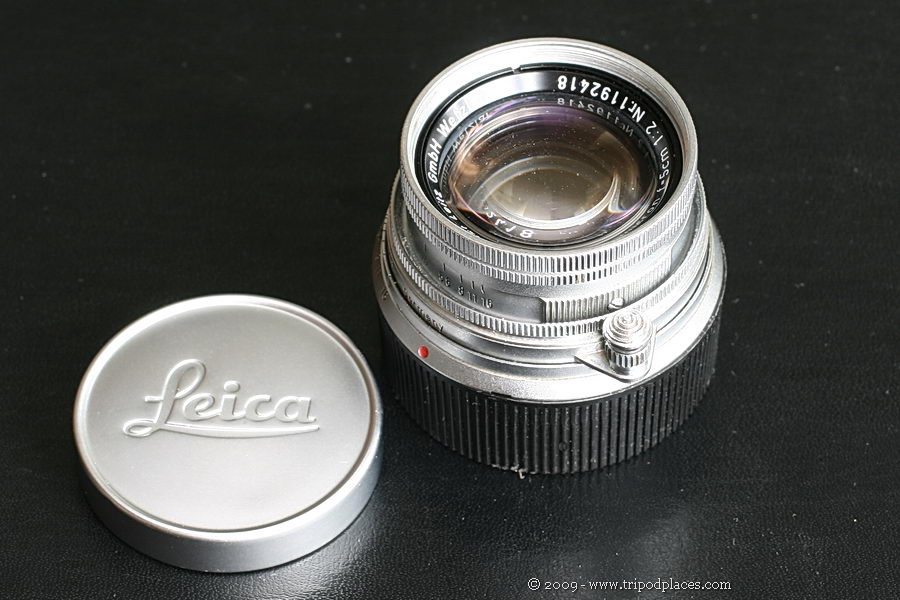
Looking around, these are considered good, if slightly dated lenses, and available for reasonable prices as well. So here she is:
Leica lens 1192418, build in Wertzlar in 1954. Unlike the camera, I got this from a seller in the States, so I did get to pay a nice customs premium, but it’s in excellent condition, and came with original front and back caps ((Interestingly enough, the ad specified it only came with a rear cap. After I bought the lens, when it was still in transit, I contacted the seller if it really didn’t come with a front cap, since I was shopping for a lens hood and matching cap. The seller confirmed it didn’t come with one, yet when it arrived, there most definitely was a front cap on it. I’m not complaining though.)). Only downside of the American heritage is the fact that the distance scale is in feet instead of meters. However, I was always pretty good in guestimating distances in feet when I played (British) table-top games, so I don’t think it’ll really matter in the end.
The camera

Wednesday, August 5th, 2009 by

Of course, to do the Leica Lessons project, I needed a Leica film rangefinder.

As I had no Leica camera, nor a rangefinder camera, I was completely free in my choice, so the first thing I did was dive into Wikipedia and find out what choices I had.

I then went over my requirements, and started scratching off options that didn’t fit:

Film
That leaves out the M8.
Leica rangefinder
No CL, which is not a Leica ((If you’re using a Leica, you might as well behave like a Leica Man.)) and no M1, which has no rangefinder.
Cheap
Scratch the M7, the MP, and possibly the M6
No meter
Anything from the M5 on is out.

That left the M3, M2 and M4.

After I then decided that my One Lens ((To rule them all.)) would be a 50mm, the choice became pretty easy. After all, only one camera had a perfect for 50mm 0.92x viewfinder magnification: The Leica M3.

To Ebay!


And here she ((All cameras are female of course: Expensive, incomprehensible and if you push the wrong buttons, things will look dark for you.)) is: Leica M3 number 1067131, made in Wetzlar, Germany in 1963, she’s nearly 20 years my senior.

The reasons I went for this one:

  • She had been CLA‘d just before sale.
  • She’s a bit beaten up (there’s a nice big dent next to the rewind knob, for example), which meant she was of no interest to collectors, keeping the price down ((I don’t care, I have a tendency to damage my cameras just so I can stop worrying about damaging them.)).
  • She’s one of the later models, with a single-stroke advance lever and the less fragile metal pressure plate. Both things I consider preferable in a camera bought for shooting, as opposed to antiquity value (made it cheaper again).
  • The seller was located in the Netherlands (like me), which prevented excess shipping costs and risks.

Back!

Monday, August 3rd, 2009 by

Just a quick note that I’m back from holiday, which was the reason for the sudden month of silence. I have a lot in the pipeline, like the final preparations for the Leica Lessons project, and pictures from the wedding I shot just before my vacation.

More to follow soon!